

Jul-2026 PECB ISO-IEC-27001-Lead-Auditor Certification Real 2026 Mock Exam
ISO-IEC-27001-Lead-Auditor Exam Questions and Valid PMP Dumps PDF
To be eligible for the PECB ISO-IEC-27001-Lead-Auditor exam, candidates must have a minimum of five years of professional experience, with at least two years of experience in information security management. They must also have completed a PECB-certified ISO/IEC 27001 Foundation training course or have equivalent knowledge. ISO-IEC-27001-Lead-Auditor exam consists of two parts: a written exam and a practical exam. The written exam is four hours long and consists of 150 multiple-choice questions. The practical exam is two hours long and requires candidates to demonstrate their auditing skills in a simulated audit scenario. Upon successful completion of both exams, candidates will be awarded the PECB Certified ISO/IEC 27001 Lead Auditor certification.
PECB ISO-IEC-27001-Lead-Auditor certification is recognized globally and is highly sought after by organizations that want to ensure the security of their information assets. With this certification, you will be able to demonstrate your commitment to maintaining the highest standards of security, and your ability to implement and maintain an effective ISMS.
PECB ISO-IEC-27001-Lead-Auditor certification exam is an essential certification for individuals who are involved in the planning, implementation, and management of an ISMS audit program. PECB Certified ISO/IEC 27001 Lead Auditor exam certification is aimed at professionals who are looking to enhance their knowledge and skills in the field of information security management systems and want to demonstrate their ability to lead an audit team. PECB Certified ISO/IEC 27001 Lead Auditor exam certification exam covers a range of topics, including the principles of information security management, the requirements of ISO/IEC 27001, and the auditing process.
NEW QUESTION # 123
Your organisation is currently seeking ISO/IEC27001:2022 certification. You have just qualified as an Internal ISMS auditor and the ICT Manager wants to use your newly acquired knowledge to assist him with the design of an information security incident management process.
He identifies the following stages in his planned process and asks you to confirm which order they should appear in.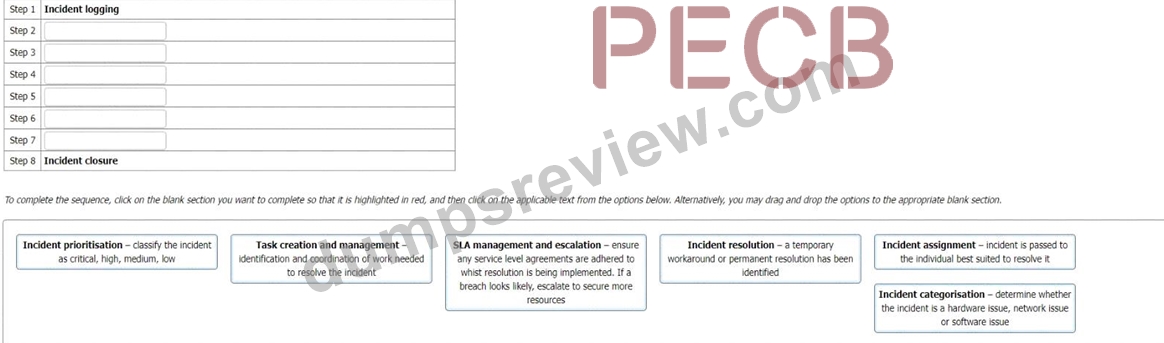
Answer:
Explanation: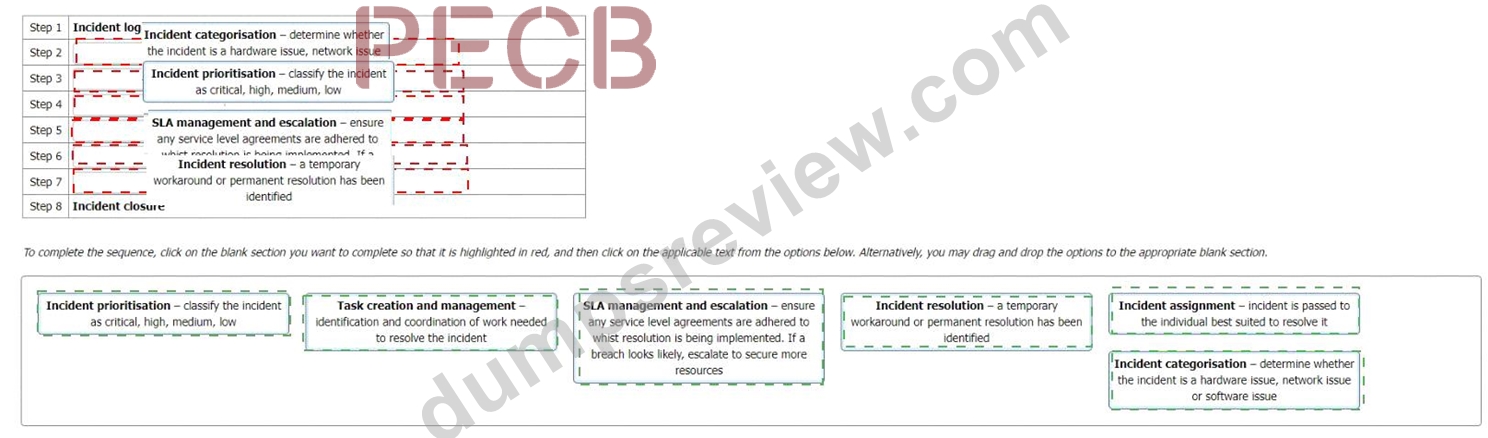
Explanation:
Step 1 = Incident logging Step 2 = Incident categorisation Step 3 = Incident prioritisation Step 4 = Incident assignment Step 5 = Task creation and management Step 6 = SLA management and escalation Step 7 = Incident resolution Step 8 = Incident closure The order of the stages in the information security incident management process should follow a logical sequence that ensures a quick, effective, and orderly response to the incidents, events, and weaknesses. The order should also be consistent with the best practices and guidance provided by ISO/IEC 27001:2022 and ISO/IEC 27035:2022. Therefore, the following order is suggested:
Step 1 = Incident logging: This step involves recording the details of the potential incident, event, or weakness, such as the date, time, source, description, impact, and reporter. This step is important to provide a traceable record of the incident and to facilitate the subsequent analysis and response. This step is related to control A.16.1.1 of ISO/IEC 27001:2022, which requires the organization to establish responsibilities and procedures for the management of information security incidents, events, and weaknesses. This step is also related to clause 6.2 of ISO/IEC 27035:2022, which provides guidance on how to log the incidents, events, and weaknesses.
Step 2 = Incident categorisation: This step involves determining the type and nature of the incident, event, or weakness, such as whether it is a hardware issue, network issue, or software issue. This step is important to classify the incident and to assign it to the appropriate resolver or team. This step is related to control A.16.1.2 of ISO/IEC 27001:2022, which requires the organization to report information security events and weaknesses as quickly as possible through appropriate management channels. This step is also related to clause 6.3 of ISO/IEC 27035:2022, which provides guidance on how to categorize the incidents, events, and weaknesses.
Step 3 = Incident prioritisation: This step involves assessing the severity and urgency of the incident, event, or weakness, and classifying it as critical, high, medium, or low. This step is important to prioritize the incident and to allocate the necessary resources and time for the response. This step is related to control A.16.1.3 of ISO/IEC 27001:2022, which requires the organization to assess and prioritize information security events and weaknesses in accordance with the defined criteria. This step is also related to clause 6.4 of ISO/IEC 27035:2022, which provides guidance on how to prioritize the incidents, events, and weaknesses.
Step 4 = Incident assignment: This step involves passing the incident, event, or weakness to the individual or team who is best suited to resolve it, based on their skills, knowledge, and availability.
This step is important to ensure that the incident is handled by the right person or team and to avoid delays or confusion. This step is related to control A.16.1.4 of ISO/IEC 27001:2022, which requires the organization to respond to information security events and weaknesses in a timely manner, according to the agreed procedures. This step is also related to clause 6.5 of ISO/IEC 27035:2022, which provides guidance on how to assign the incidents, events, and weaknesses.
Step 5 = Task creation and management: This step involves identifying and coordinating the work needed to resolve the incident, event, or weakness, such as performing root cause analysis, testing solutions, implementing changes, and documenting actions. This step is important to ensure that the incident is resolved effectively and efficiently, and that the actions are tracked and controlled. This step is related to control A.16.1.5 of ISO/IEC 27001:2022, which requires the organization to apply lessons learned from information security events and weaknesses to take corrective and preventive actions. This step is also related to clause 6.6 of ISO/IEC 27035:2022, which provides guidance on how to create and manage the tasks for the incidents, events, and weaknesses.
Step 6 = SLA management and escalation: This step involves ensuring that any service level agreements (SLAs) are adhered to while the resolution is being implemented, and that the incident is escalated to a higher level of authority or support if a breach looks likely or occurs. This step is important to ensure that the incident is resolved within the agreed time frame and quality, and that any deviations or issues are communicated and addressed. This step is related to control A.16.1.6 of ISO/IEC 27001:2022, which requires the organization to communicate information security events and weaknesses to the relevant internal and external parties, as appropriate. This step is also related to clause 6.7 of ISO/IEC
27035:2022, which provides guidance on how to manage the SLAs and escalations for the incidents, events, and weaknesses.
Step 7 = Incident resolution: This step involves applying a temporary workaround or a permanent solution to resolve the incident, event, or weakness, and restoring the normal operation of the information and information processing facilities. This step is important to ensure that the incident is resolved completely and satisfactorily, and that the information security is restored to the desired level.
This step is related to control A.16.1.7 of ISO/IEC 27001:2022, which requires the organization to identify the cause of information security events and weaknesses, and to take actions to prevent their recurrence or occurrence. This step is also related to clause 6.8 of ISO/IEC 27035:2022, which provides guidance on how to resolve the incidents, events, and weaknesses.
Step 8 = Incident closure: This step involves closing the incident, event, or weakness, after verifying that it has been resolved satisfactorily, and that all the actions have been completed and documented.
This step is important to ensure that the incident is formally closed and that no further actions are required. This step is related to control A.16.1.8 of ISO/IEC 27001:2022, which requires the organization to collect evidence and document the information security events and weaknesses, and the actions taken. This step is also related to clause 6.9 of ISO/IEC 27035:2022, which provides guidance on how to close the incidents, events, and weaknesses.
References:
ISO/IEC 27001:2022, Information technology - Security techniques - Information security management systems - Requirements1 PECB Candidate Handbook ISO/IEC 27001 Lead Auditor2 ISO 27001:2022 Lead Auditor - PECB3 ISO 27001:2022 certified ISMS lead auditor - Jisc4 ISO/IEC 27001:2022 Lead Auditor Transition Training Course5 ISO 27001 - Information Security Lead Auditor Course - PwC Training Academy6 ISO/IEC 27035:2022, Information technology - Security techniques - Information security incident management
NEW QUESTION # 124
What is a repressive measure in case of a fire?
- A. Repairing damage caused by the fire
- B. Taking out a fire insurance
- C. Putting out a fire after it has been detected by a fire detector
Answer: C
Explanation:
Explanation
A repressive measure is a measure that aims to reduce or eliminate the impact of an incident after it has occurred. Putting out a fire after it has been detected by a fire detector is an example of a repressive measure, as it reduces the damage caused by the fire. Taking out a fire insurance is not a repressive measure, but a corrective measure, as it compensates for the loss after the incident. Repairing damage caused by the fire is also not a repressive measure, but a recovery measure, as it restores the normal operation after the incident. References: : CQI & IRCA ISO 27001:2022 Lead Auditor Course Handbook, page 28. : CQI & IRCA ISO 27001:2022 Lead Auditor Course Handbook, page 29. : CQI & IRCA ISO 27001:2022 Lead Auditor Course Handbook, page 30.
NEW QUESTION # 125
Scenario 7: Webvue. headquartered in Japan, is a technology company specializing in the development, support, and maintenance of computer software. Webvue provides solutions across various technology fields and business sectors. Its flagship service is CloudWebvue, a comprehensive cloud computing platform offering storage, networking, and virtual computing services. Designed for both businesses and individual users. CloudWebvue is known for its flexibility, scalability, and reliability.
Webvue has decided to only include CloudWebvue in its ISO/IEC 27001 certification scope. Thus, the stage 1 and 2 audits were performed simultaneously Webvue takes pride in its strictness regarding asset confidentiality They protect the information stored in CloudWebvue by using appropriate cryptographic controls. Every piece of information of any classification level, whether for internal use. restricted, or confidential, is first encrypted with a unique corresponding hash and then stored in the cloud The audit team comprised five persons Keith. Sean. Layla, Sam. and Tina. Keith, the most experienced auditor on the IT and information security auditing team, was the audit team leader. His responsibilities included planning the audit and managing the audit team. Sean and Layla were experienced in project planning, business analysis, and IT systems (hardware and application) Their tasks included audit planning according to Webvue's internal systems and processes Sam and Tina, on the other hand, who had recently completed their education, were responsible for completing the day-to-day tasks while developing their audit skills While verifying conformity to control 8.24 Use of cryptography of ISO/IEC 27001 Annex A through interviews with the relevant staff, the audit team found out that the cryptographic keys have been initially generated based on random bit generator (RBG) and other best practices for the generation of the cryptographic keys. After checking Webvue's cryptography policy, they concluded that the information obtained by the interviews was true. However, the cryptographic keys are still in use because the policy does not address the use and lifetime of cryptographic keys.
As later agreed upon between Webvue and the certification body, the audit team opted to conduct a virtual audit specifically focused on verifying conformity to control 8.11 Data Masking of ISO/IEC 27001 within Webvue, aligning with the certification scope and audit objectives. They examined the processes involved in protecting data within CloudWebvue. focusing on how the company adhered to its policies and regulatory standards. As part of this process. Keith, the audit team leader, took screenshot copies of relevant documents and cryptographic key management procedures to document and analyze the effectiveness of Webvue's practices.
Webvue uses generated test data for testing purposes. However, as determined by both the interview with the manager of the QA Department and the procedures used by this department, sometimes live system data are used. In such scenarios, large amounts of data are generated while producing more accurate results. The test data is protected and controlled, as verified by the simulation of the encryption process performed by Webvue's personnel during the audit While interviewing the manager of the QA Department, Keith observed that employees in the Security Training Department were not following proper procedures, even though this department fell outside the audit scope. Despite the exclusion in the audit scope, the non conformity in the Security Training Department has potential implications for the processes within the audit scope, specifically impacting data security and cryptographic practices in CloudWebvue. Therefore, Keith incorporated this finding into the audit report and accordingly informed the auditee.
Based on the scenario above, answer the following question:
Question:
Based on Scenario 7, was Keith's choice regarding the incorporation of the Security Training Department in the audit report appropriate?
- A. Yes, he should have incorporated the Security Training Department in the audit report
- B. No, he should have included it without informing the auditee about the observed situation
- C. No, he should not have included it and only informed the auditee about the observed situation
Answer: A
Explanation:
Comprehensive and Detailed In-Depth Explanation:
* A. Correct Answer:
* ISO 19011:2018 allows auditors to report significant issues that impact the audit scope, even if they arise outside the predefined scope.
* Security Training Department nonconformities directly affected CloudWebvue's ISMS, justifying its inclusion in the audit report.
* B. Incorrect:
* Transparency is crucial in audits, and Keith correctly informed the auditee before reporting.
* C. Incorrect:
* Issues affecting ISMS implementation must be reported, as they pose risks to the certification scope.
Relevant Standard Reference:
* ISO 19011:2018 Clause 6.6.1 (Audit Reporting on Nonconformities Outside Scope but with Impact)
NEW QUESTION # 126
An organisation is looking for management system initial certification. Please identify the sequence of the activities to be undertaken by the organisation.
To complete the sequence click on the blank section you want to complete so that it is highlighted in red, and then click on the applicable text from the options below. Alternatively, you may drag and drop the options to the appropriate blank section.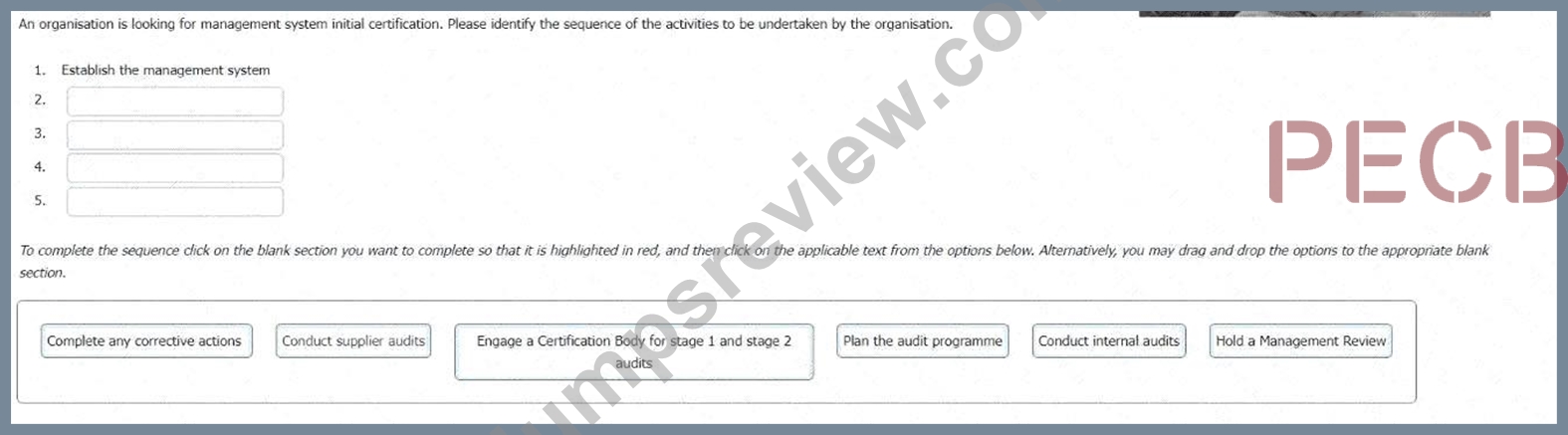
Answer:
Explanation: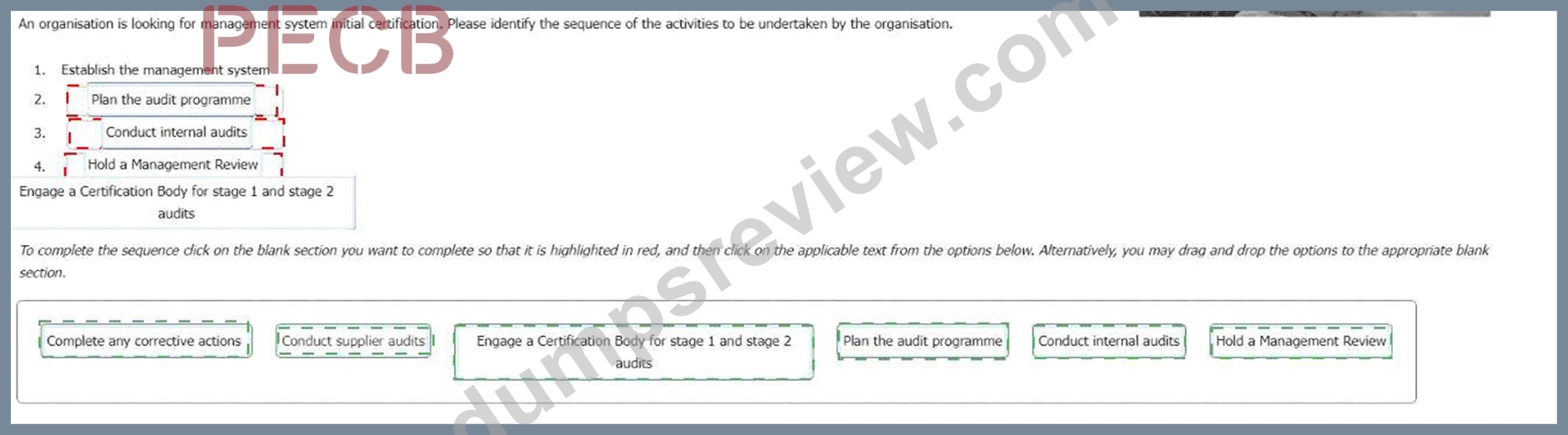
Explanation:
The correct sequence of activities is:
* Establish the management system
* Plan the audit programme
* Conduct internal audits
* Hold a Management Review
* Engage a Certification Body for stage 1 and stage 2 audits
* Complete any corrective actions
Comprehensive but Short Explanation: = According to the PECB Candidate Handbook - ISO/IEC 27001 Lead Auditor, the steps for achieving certification are as follows1:
* Establish the management system: This involves defining the scope, objectives, policies, procedures, and controls of the ISMS, as well as ensuring the availability of resources and top management commitment.
* Plan the audit programme: This involves defining the audit objectives, criteria, scope, frequency, methods, and responsibilities for conducting internal audits of the ISMS.
* Conduct internal audits: This involves verifying the conformity and effectiveness of the ISMS, as well as identifying any nonconformities or opportunities for improvement.
* Hold a Management Review: This involves reviewing the performance and suitability of the ISMS, as well as deciding on any changes or actions needed to improve it.
* Engage a Certification Body for stage 1 and stage 2 audits: This involves selecting a reputable and accredited certification body to conduct an external audit of the ISMS, consisting of two stages: a documentation review and an on-site assessment.
* Complete any corrective actions: This involves addressing any nonconformities or findings identified by the certification body, and providing evidence of their implementation and effectiveness.
= 1: PECB Candidate Handbook - ISO/IEC 27001 Lead Auditor, pages 25-26.
NEW QUESTION # 127
You are performing an ISMS audit at a residential nursing home that provides healthcare services. The next step in your audit plan is to verify the information security incident management process. The IT Security Manager presents the information security incident management procedure and explains that the process is based on ISO/IEC 27035-1:2016.
You review the document and notice a statement "any information security weakness, event, and incident should be reported to the Point of Contact (PoC) within 1 hour after identification". When interviewing staff, you found that there were differences in the understanding of the meaning of "weakness, event, and incident".
You sample incident report records from the event tracking system for the last 6 months with summarized results in the following table.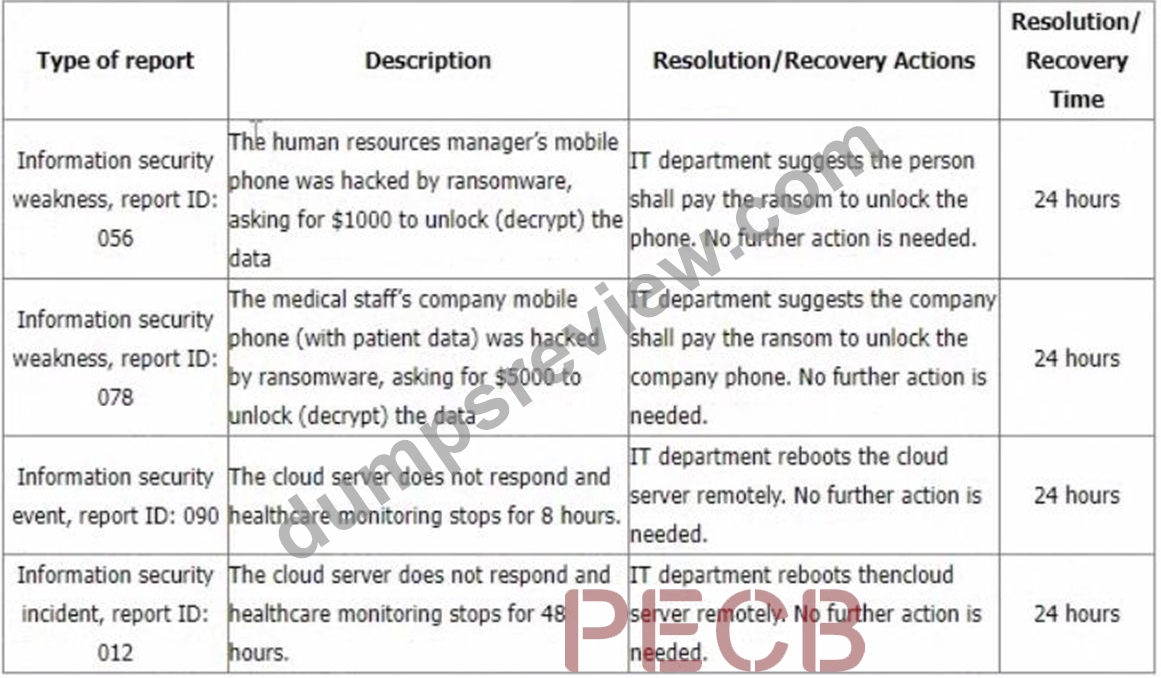
You would like to further investigate other areas to collect more audit evidence. Select two options that will not be in your audit trail.
- A. Collect more evidence on how the organisation determined the incident recovery time. (Relevant to control A.5.27)
- B. Collect more evidence on how and when the company pays the ransom fee to unlock the company's mobile phone and data, i.e., credit card, and bank transfer. (Relevant to control A.5.26)
- C. Collect more evidence on the incident recovery procedures. (Relevant to control A.5.26)
- D. Collect more evidence on how the organization determined no further action was needed after the incident. (Relevant to control A.5.26)
- E. Collect more evidence by interviewing more staff about their understanding of the reporting process. (Relevant to control A.6.8)
- F. Collect more evidence on how and when the Human Resources manager pays the ransom fee to unlock personal mobile data, i.e., credit card, and bank transfer. (Relevant to control A.5.26)
Answer: B,F
Explanation:
* C . Collect more evidence on how and when the Human Resources manager pays the ransom fee to unlock personal mobile data, i.e., credit card, and bank transfer. (Relevant to control A.5.26) This is not relevant to the audit of the organization's incident management process. The HR manager's personal phone and how they handle a ransomware attack on it falls outside the scope of the ISMS audit. The organization is not responsible for personal devices.
* B . Collect more evidence on how and when the company pays the ransom fee to unlock the company's mobile phone and data, i.e., credit card, and bank transfer. (Relevant to control A.5.26) While seemingly relevant, this focuses on the method of payment for the ransom. The core issue is the organization paying the ransom at all, which is generally not best practice in incident response. The audit should focus on why this decision was made and if alternative solutions were considered (e.g., data backups, device wiping and restoration).
Why the other options ARE relevant:
* A . Collect more evidence by interviewing more staff about their understanding of the reporting process. (Relevant to control A.6.8) This directly addresses the identified discrepancy in understanding "weakness, event, and incident," which is crucial for proper incident reporting.
* D . Collect more evidence on how the organisation determined the incident recovery time. (Relevant to control A.5.27) This investigates the basis for the 24-hour recovery time, which seems arbitrary and may not be appropriate for all incidents.
* E . Collect more evidence on how the organization determined no further action was needed after the incident. (Relevant to control A.5.26) This probes the adequacy of the incident response, especially the lack of preventative measures after paying the ransom.
* F . Collect more evidence on the incident recovery procedures. (Relevant to control A.5.26) This examines the actual procedures to assess their effectiveness and alignment with best practices.
NEW QUESTION # 128
Question:
How does predictive analytics help auditors in identifying potential risks?
- A. By providing real-time analysis of financial data
- B. By predicting future outcomes based on trends
- C. By organizing data from various sources
Answer: B
Explanation:
Comprehensive and Detailed In-Depth Explanation:
* B. Correct Answer:
* Predictive analytics uses historical data, machine learning, and statistical models to predict future risk events.
* It identifies patterns in security incidents, financial trends, and operational failures to anticipate risks before they occur.
* A. Incorrect:
* Real-time analysis is part of monitoring, but predictive analytics focuses on forecasting risks, not just real-time reporting.
* C. Incorrect:
* Data organization is essential but does not involve forecasting risks.
Relevant Standard Reference:
* ISO 31000:2018 (Risk Management - Guidelines on Using Data Analytics in Risk Assessment)
NEW QUESTION # 129
A key audit process is the way auditors gather information and determine the findings' characteristics. Put the actions listed in the correct order to complete this process. The last one has been done for you.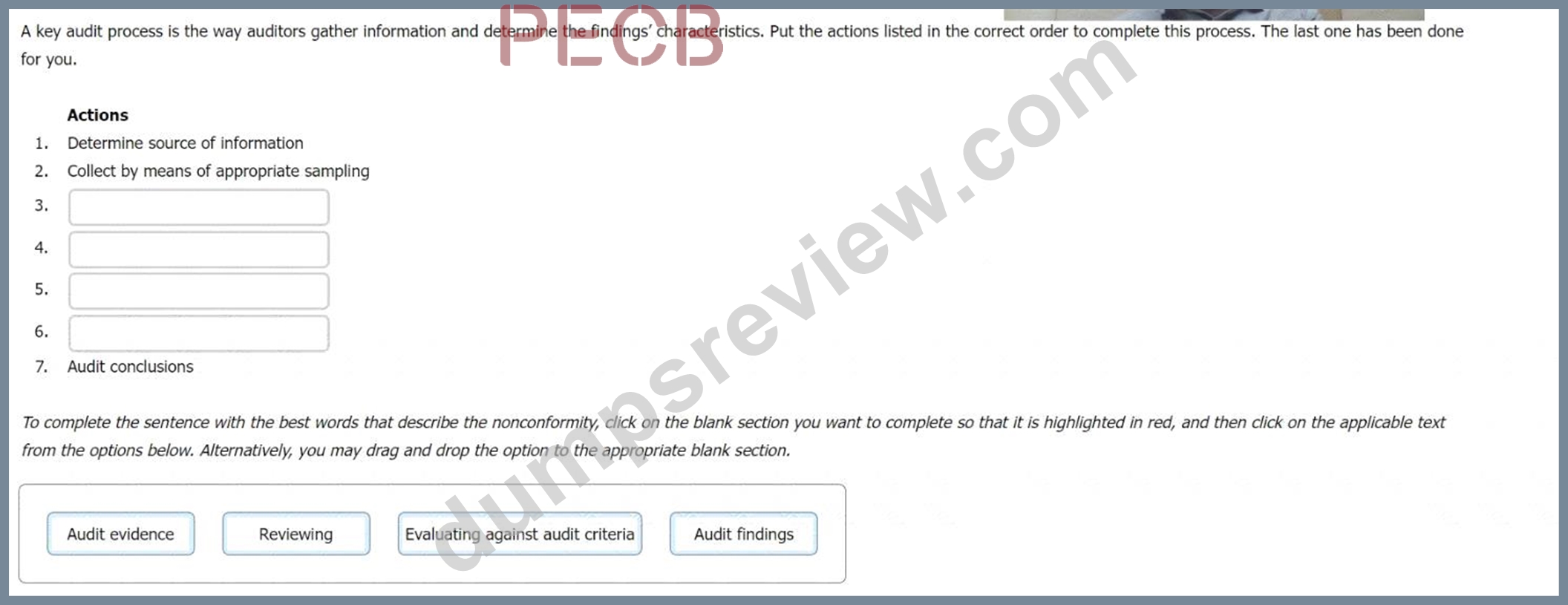
Answer:
Explanation: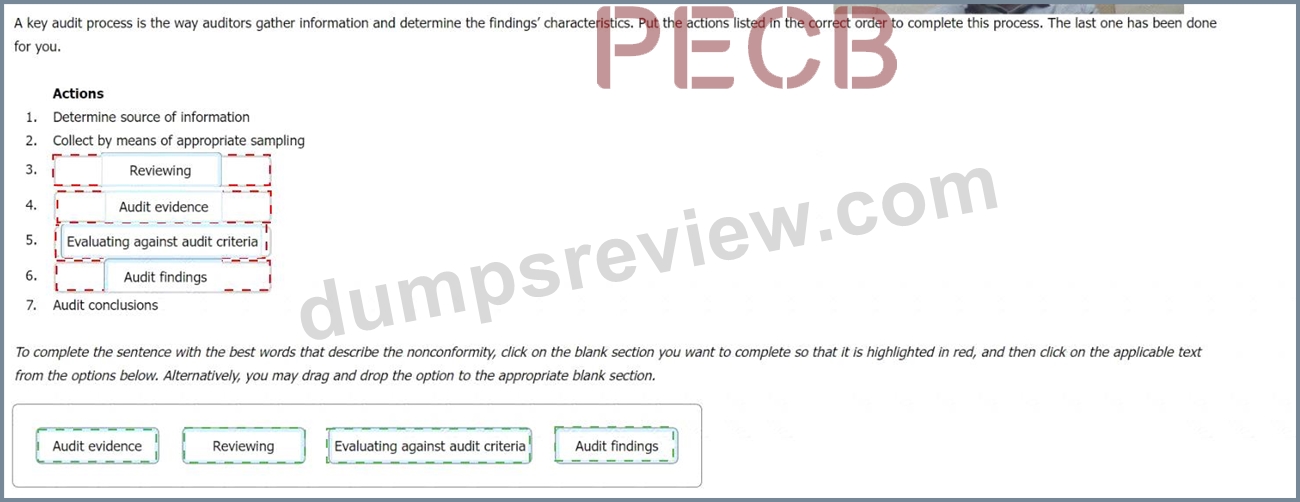
Explanation
* Determine source of information
* Collect by means of appropriate sampling
* Reviewing
* Audit evidence
* Evaluating against audit criteria
* Audit findings
* Audit conclusions
The reviewing step involves checking the accuracy, completeness, and relevance of the collected information.
The audit evidence step involves documenting the information in a verifiable and traceable manner. The evaluating against audit criteria step involves comparing the audit evidence with the requirements of the ISO
27001 standard and the organization's own policies and objectives. The audit findings step involves identifying any nonconformities, weaknesses, or opportunities for improvement in the ISMS. The audit conclusions step involves summarizing the audit results and providing recommendations for corrective actions or enhancements.
NEW QUESTION # 130
You are conducting a third-party surveillance audit when another member of the audit team approaches you seeking clarification. They have been asked to assess the organisation's application of control 5.7 - Threat Intelligence. They are aware that this is one of the new controls introduced in the 2022 edition of ISO/IEC
27001, and they want to make sure they audit the control correctly.
They have prepared a checklist to assist them with their audit and want you to confirm that their planned activities are aligned with the control's requirements.
Which three of the following options represent valid audit trails?
- A. I will review the organisation's threat intelligence process and will ensure that this is fully documented
- B. I will ensure that appropriate measures have been introduced to inform top management as to the effectiveness of current threat intelligence arrangements
- C. I will check that threat intelligence is actively used to protect the confidentiality, integrity and availability of the organisation's information assets
- D. I will ensure that the task of producing threat intelligence is assigned to the organisation s internal audit team
- E. I will determine whether internal and external sources of information are used in the production of threat intelligence
- F. I will review how information relating to information security threats is collected and evaluated to produce threat intelligence
- G. I will ensure that the organisation's risk assessment process begins with effective threat intelligence
- H. I will speak to top management to make sure all staff are aware of the importance of reporting threats
Answer: A,C,E
Explanation:
According to ISO/IEC 27001:2022, which specifies the requirements for establishing, implementing, maintaining and continually improving an information security management system (ISMS), control 5.7 requires an organization to establish and maintain a threat intelligence process to identify and evaluate information security threats that are relevant to its ISMS scope and objectives1. The organization should use internal and external sources of information, such as vulnerability databases, threat feeds, industry reports, etc., to produce threat intelligence that can be used to support risk assessment and treatment, as well as other information security activities1. Therefore, when auditing the organization's application of control 5.7, an ISMS auditor should verify that these aspects are met in accordance with the audit criteria.
Three options that represent valid audit trails for verifying control 5.7 are:
* I will review the organisation's threat intelligence process and will ensure that this is fully documented:
This option is valid because it can provide evidence of how the organization has established and maintained a threat intelligence process that is consistent with its ISMS scope and objectives. It can also verify that the process is documented according to clause 7.5 of ISO/IEC 27001:20221.
* I will check that threat intelligence is actively used to protect the confidentiality, integrity and availability of the organisation's information assets: This option is valid because it can provide evidence of how the organization has used threat intelligence to support its risk assessment and treatment, as well as other information security activities, such as incident response, awareness, or monitoring. It can also verify that the organization has achieved its information security objectives according to clause 6.2 of ISO/IEC 27001:20221.
* I will determine whether internal and external sources of information are used in the production of threat intelligence: This option is valid because it can provide evidence of how the organization has used various sources of information, such as vulnerability databases, threat feeds, industry reports, etc., to produce threat intelligence that is relevant and reliable. It can also verify that the organization has complied with the requirement of control 5.7 of ISO/IEC 27001:20221.
The other options are not valid audit trails for verifying control 5.7, as they are not related to the control or its requirements. For example:
* I will speak to top management to make sure all staff are aware of the importance of reporting threats:
This option is not valid because it does not provide evidence of how the organization has established and maintained a threat intelligence process or used threat intelligence to support its ISMS activities. It may be related to another control or requirement regarding information security awareness or communication, but not specifically to control 5.7.
* I will ensure that the task of producing threat intelligence is assigned to the organisation s internal audit team: This option is not valid because it does not provide evidence of how the organization has established and maintained a threat intelligence process or used threat intelligence to support its ISMS activities. It may also contradict the requirement for auditor independence and objectivity, as recommended by ISO 19011:20182, which provides guidelines for auditing management systems.
* I will ensure that the organisation's risk assessment process begins with effective threat intelligence:
This option is not valid because it does not provide evidence of how the organization has established and maintained a threat intelligence process or used threat intelligence to support its ISMS activities. It may also imply a prescriptive approach to risk assessment that is not consistent with ISO/IEC 27005:
20183, which provides guidelines for information security risk management.
* I will review how information relating to information security threats is collected and evaluated to produce threat intelligence: This option is not valid because it does not provide evidence of how the organization has established and maintained a threat intelligence process or used threat intelligence to support its ISMS activities. It may also be too vague or broad to be an effective audit trail, as it does not specify what criteria or methods are used for collecting and evaluating information.
* I will ensure that appropriate measures have been introduced to inform top management as to the effectiveness of current threat intelligence arrangements: This option is not valid because it does not provide evidence of how the organization has established and maintained a threat intelligence process or used threat intelligence to support its ISMS activities. It may be related to another control or requirement regarding management review or performance evaluation, but not specifically to control
5.7.
References: ISO/IEC 27001:2022 - Information technology - Security techniques - Information security management systems - Requirements, ISO 19011:2018 - Guidelines for auditing management systems, ISO
/IEC 27005:2018 - Information technology - Security techniques - Information security risk management
NEW QUESTION # 131
Which two of the following statements are true?
- A. The role of a certification body auditor involves evaluating the organisation's processes for ensuring compliance with their legal requirements
- B. As part of a certification body audit the auditor is resporable for verifying the organisation's legal compliance status
- C. Curing a third-party audit, the auditor evaluates how the organisation ensures that 4 6 made aware of changes to the legal requirements
Answer: A,C
Explanation:
The following statements are true:
* The role of a certification body auditor involves evaluating the organization's processes for ensuring compliance with their legal requirements. This is part of the auditor's responsibility to assess the effectiveness and conformity of the organization's ISMS against the ISO/IEC 27001:2022 standard and the applicable legal and regulatory requirements.
* During a third-party audit, the auditor evaluates how the organization ensures that they are made aware of changes to the legal requirements. This is part of the auditor's responsibility to verify that the organization has established and maintained a process for identifying and updating their legal and other requirements related to information security. The following statement is false:
* As part of a certification body audit, the auditor is responsible for verifying the organization's legal compliance status. This is not true, as the auditor is not authorized or qualified to provide legal advice or judgment on the organization's compliance status. The auditor can only report on the evidence of compliance or noncompliance observed during the audit, but the ultimate responsibility for ensuring legal compliance lies with the organization. References: : CQI & IRCA ISO 27001:2022 Lead Auditor Course Handbook, page 66. : CQI & IRCA ISO 27001:2022 Lead Auditor Course Handbook, page 67.
: ISO/IEC 27001 LEAD AUDITOR - PECB, page 22.
NEW QUESTION # 132
You are conducting a third-party surveillance audit when another member of the audit team approaches you seeking clarification. They have been asked to assess the organisation's application of control 5.7 - Threat Intelligence. They are aware that this is one of the new controls introduced in the 2022 edition of ISO/IEC
27001, and they want to make sure they audit the control correctly.
They have prepared a checklist to assist them with their audit and want you to confirm that their planned activities are aligned with the control's requirements.
Which three of the following options represent valid audit trails?
- A. I will review the organisation's threat intelligence process and will ensure that this is fully documented
- B. I will ensure that appropriate measures have been introduced to inform top management as to the effectiveness of current threat intelligence arrangements
- C. I will check that threat intelligence is actively used to protect the confidentiality, integrity and availability of the organisation's information assets
- D. I will ensure that the task of producing threat intelligence is assigned to the organisation s internal audit team
- E. I will determine whether internal and external sources of information are used in the production of threat intelligence
- F. I will review how information relating to information security threats is collected and evaluated to produce threat intelligence
- G. I will ensure that the organisation's risk assessment process begins with effective threat intelligence
- H. I will speak to top management to make sure all staff are aware of the importance of reporting threats
Answer: A,C,E
Explanation:
According to ISO/IEC 27001:2022, which specifies the requirements for establishing, implementing, maintaining and continually improving an information security management system (ISMS), control 5.7 requires an organization to establish and maintain a threat intelligence process to identify and evaluate information security threats that are relevant to its ISMS scope and objectives1. The organization should use internal and external sources of information, such as vulnerability databases, threat feeds, industry reports, etc., to produce threat intelligence that can be used to support risk assessment and treatment, as well as other information security activities1. Therefore, when auditing the organization's application of control 5.7, an ISMS auditor should verify that these aspects are met in accordance with the audit criteria.
Three options that represent valid audit trails for verifying control 5.7 are:
* I will review the organisation's threat intelligence process and will ensure that this is fully documented:
This option is valid because it can provide evidence of how the organization has established and maintained a threat intelligence process that is consistent with its ISMS scope and objectives. It can also verify that the process is documented according to clause 7.5 of ISO/IEC 27001:20221.
* I will check that threat intelligence is actively used to protect the confidentiality, integrity and availability of the organisation's information assets: This option is valid because it can provide evidence of how the organization has used threat intelligence to support its risk assessment and treatment, as well as other information security activities, such as incident response, awareness, or monitoring. It can also verify that the organization has achieved its information security objectives according to clause 6.2 of ISO/IEC 27001:20221.
* I will determine whether internal and external sources of information are used in the production of threat intelligence: This option is valid because it can provide evidence of how the organization has used various sources of information, such as vulnerability databases, threat feeds, industry reports, etc., to produce threat intelligence that is relevant and reliable. It can also verify that the organization has complied with the requirement of control 5.7 of ISO/IEC 27001:20221.
The other options are not valid audit trails for verifying control 5.7, as they are not related to the control or its requirements. For example:
* I will speak to top management to make sure all staff are aware of the importance of reporting threats:
This option is not valid because it does not provide evidence of how the organization has established and maintained a threat intelligence process or used threat intelligence to support its ISMS activities. It may be related to another control or requirement regarding information security awareness or communication, but not specifically to control 5.7.
* I will ensure that the task of producing threat intelligence is assigned to the organisation s internal audit team: This option is not valid because it does not provide evidence of how the organization has established and maintained a threat intelligence process or used threat intelligence to support its ISMS activities. It may also contradict the requirement for auditor independence and objectivity, as recommended by ISO 19011:20182, which provides guidelines for auditing management systems.
* I will ensure that the organisation's risk assessment process begins with effective threat intelligence:
This option is not valid because it does not provide evidence of how the organization has established and maintained a threat intelligence process or used threat intelligence to support its ISMS activities. It may also imply a prescriptive approach to risk assessment that is not consistent with ISO/IEC 27005:20183, which provides guidelines for information security risk management.
* I will review how information relating to information security threats is collected and evaluated to produce threat intelligence: This option is not valid because it does not provide evidence of how the
* organization has established and maintained a threat intelligence process or used threat intelligence to support its ISMS activities. It may also be too vague or broad to be an effective audit trail, as it does not specify what criteria or methods are used for collecting and evaluating information.
* I will ensure that appropriate measures have been introduced to inform top management as to the effectiveness of current threat intelligence arrangements: This option is not valid because it does not provide evidence of how the organization has established and maintained a threat intelligence process or used threat intelligence to support its ISMS activities. It may be related to another control or requirement regarding management review or performance evaluation, but not specifically to control 5.7.
References: ISO/IEC 27001:2022 - Information technology - Security techniques - Information security management systems - Requirements, ISO 19011:2018 - Guidelines for auditing management systems, ISO/IEC 27005:2018 - Information technology - Security techniques - Information security risk management
NEW QUESTION # 133
Which two of the following phrases are 'objectives' in relation to a first-party audit?
- A. Update the management policy
- B. Complete the audit on time
- C. Confirm the scope of the management system is accurate
- D. Apply international standards
- E. Prepare the audit report for the certification body
- F. Apply Regulatory requirements
Answer: A,C
Explanation:
A first-party audit is an internal audit conducted by the organization itself or by an external party on its behalf. The objectives of a first-party audit are to: 12
* Confirm the scope of the management system is accurate, i.e., it covers all the processes, activities, locations, and functions that are relevant to the information security objectives and requirements of the organization.
* Update the management policy, i.e., review and revise the policy statement, roles and responsibilities, and objectives and targets of the information security management system (ISMS) based on the audit findings and feedback.
The other phrases are not objectives of a first-party audit, but rather:
* Apply international standards: This is a requirement for the ISMS, not an objective of the audit. The ISMS must conform to the ISO/IEC 27001 standard and any other applicable standards or regulations12
* Prepare the audit report for the certification body: This is an activity of a third-party audit, not a first-party audit. A third-party audit is an external audit conducted by an independent certification body to verify the conformity and effectiveness of the ISMS and to issue a certificate of compliance12
* Complete the audit on time: This is a performance indicator, not an objective of the audit. The audit
* should be completed within the planned time frame and budget, but this is not the primary purpose of the audit12
* Apply regulatory requirements: This is also a requirement for the ISMS, not an objective of the audit. The ISMS must comply with the legal and contractual obligations of the organization regarding information security12 References:
1: ISO/IEC 27001:2022 Lead Auditor (Information Security Management Systems) Course by CQI and IRCA Certified Training 1 2: ISO/IEC 27001 Lead Auditor Training Course by PECB 2
NEW QUESTION # 134
Which situation presented below represents a threat?
- A. An organization fails to implement multi-factor authentication (MFA) for its cloud services
- B. Cyber attackers infiltrated the network by exploiting a zero-day vulnerability in the organization's firewall software
- C. An employee accesses unauthorized files using their legitimate credentials
Answer: B
Explanation:
Comprehensive and Detailed In-Depth
C . Correct Answer - This is a Threat. A cyberattack exploiting a zero-day vulnerability is an active security threat, as it causes harm to the organization.
A . Employee accessing unauthorized files is a vulnerability (insider risk) rather than an external threat.
B . Lack of MFA is a security weakness (vulnerability), not a threat.
NEW QUESTION # 135
According to ISO/IEC 27001, an Information Security Management System seeks to protect which two of the following?
- A. The integration of information
- B. The integrity of information
- C. The authenticity of information
- D. The accessibility of information
- E. The consistency of information
- F. The confidentiality of information
Answer: B,F
Explanation:
ISO/IEC 27001 focuses on the core principles of the CIA triad:
* Confidentiality: Ensuring information is accessible only to authorized individuals.
* Integrity: Maintaining the accuracy and completeness of information, protecting it from unauthorized modification.
* Availability: Information should be accessible to authorized users when needed (this is also important, but not one of the choices in this specific question).
Reference:
* ISO/IEC 27001:2022, Section 4.2 (Understanding the needs and expectations of interested parties): This section highlights the importance of determining relevant interested parties and their requirements related to information security, which includes addressing confidentiality, integrity, and availability.
NEW QUESTION # 136
Scenario 7: Webvue. headquartered in Japan, is a technology company specializing in the development, support, and maintenance of computer software. Webvue provides solutions across various technology fields and business sectors. Its flagship service is CloudWebvue, a comprehensive cloud computing platform offering storage, networking, and virtual computing services. Designed for both businesses and individual users. CloudWebvue is known for its flexibility, scalability, and reliability.
Webvue has decided to only include CloudWebvue in its ISO/IEC 27001 certification scope. Thus, the stage 1 and 2 audits were performed simultaneously Webvue takes pride in its strictness regarding asset confidentiality They protect the information stored in CloudWebvue by using appropriate cryptographic controls. Every piece of information of any classification level, whether for internal use. restricted, or confidential, is first encrypted with a unique corresponding hash and then stored in the cloud The audit team comprised five persons Keith. Sean. Layla, Sam. and Tina. Keith, the most experienced auditor on the IT and information security auditing team, was the audit team leader. His responsibilities included planning the audit and managing the audit team. Sean and Layla were experienced in project planning, business analysis, and IT systems (hardware and application) Their tasks included audit planning according to Webvue's internal systems and processes Sam and Tina, on the other hand, who had recently completed their education, were responsible for completing the day-to-day tasks while developing their audit skills While verifying conformity to control 8.24 Use of cryptography of ISO/IEC 27001 Annex A through interviews with the relevant staff, the audit team found out that the cryptographic keys have been initially generated based on random bit generator (RBG) and other best practices for the generation of the cryptographic keys. After checking Webvue's cryptography policy, they concluded that the information obtained by the interviews was true. However, the cryptographic keys are still in use because the policy does not address the use and lifetime of cryptographic keys.
As later agreed upon between Webvue and the certification body, the audit team opted to conduct a virtual audit specifically focused on verifying conformity to control 8.11 Data Masking of ISO/IEC 27001 within Webvue, aligning with the certification scope and audit objectives. They examined the processes involved in protecting data within CloudWebvue. focusing on how the company adhered to its policies and regulatory standards. As part of this process. Keith, the audit team leader, took screenshot copies of relevant documents and cryptographic key management procedures to document and analyze the effectiveness of Webvue's practices.
Webvue uses generated test data for testing purposes. However, as determined by both the interview with the manager of the QA Department and the procedures used by this department, sometimes live system data are used. In such scenarios, large amounts of data are generated while producing more accurate results. The test data is protected and controlled, as verified by the simulation of the encryption process performed by Webvue's personnel during the audit While interviewing the manager of the QA Department, Keith observed that employees in the Security Training Department were not following proper procedures, even though this department fell outside the audit scope. Despite the exclusion in the audit scope, the non conformity in the Security Training Department has potential implications for the processes within the audit scope, specifically impacting data security and cryptographic practices in CloudWebvue. Therefore, Keith incorporated this finding into the audit report and accordingly informed the auditee.
Based on the scenario above, answer the following question:
Question:
Based on Scenario 7, the audit team checked Webvue's cryptography policy to obtain reasonable assurance of the information obtained during interviews. Which type of audit procedure has been used?
- A. Corroboration
- B. Observation
- C. Evaluation
Answer: A
Explanation:
Comprehensive and Detailed In-Depth Explanation:
* B. Correct answer:
* Corroboration is the process of validating verbal statements with documented evidence.
* ISO 19011:2018 emphasizes cross-verification of audit evidence to ensure accuracy.
* A. Incorrect:
* Observation involves witnessing real-time processes, but here, the audit team compared interview data with documentation.
* C. Incorrect:
* Evaluation assesses compliance with criteria, but corroboration focuses on evidence validation.
Relevant Standard Reference:
* ISO 19011:2018 Clause 6.4.7 (Corroboration of Audit Evidence)
NEW QUESTION # 137
Which is not a requirement of HR prior to hiring?
- A. Undergo background verification
- B. Must successfully pass Background Investigation
- C. Must undergo Awareness training on information security.
- D. Applicant must complete pre-employment documentation requirements
Answer: C
Explanation:
Explanation
According to ISO/IEC 27001:2022, clause 7.2.2, the organization shall ensure that all persons who have access to information are aware of the information security policy and their contribution to the effectiveness of the ISMS, including the benefits of improved information security performance2. Therefore, awareness training on information security is a requirement for all persons, not just new hires. References: ISO/IEC 27001:2022 Lead Auditor (Information Security Management Systems) | CQI | IRCA
NEW QUESTION # 138
You are an experienced ISMS audit team leader conducting a third-party surveillance audit of an internet services provider. You are reviewing the organization's risk assessment processes for conformity with ISO/IEC 27001:2022.
Which three of the following audit findings would prompt you to raise a nonconformity report?
- A. The organisation's risk assessment criteria have not been reviewed and approved by top management
- B. The organisation has assessed the probability of all of its information security risks as either 0%, 25%, 50%, 75% or 100%
- C. The organisation's information security risk assessment process suggests each risk is allocated a risk owner
- D. There is a different system in place for assessing operational information security risks and for assessing strategic information security risks
- E. The organisation is treating information security risks in the order in which they are identified
- F. Both systems contain additional information security risks which are not associated with preserving the confidentiality, integrity and accessibility of information
- G. The organisation has not used RAG (Red, Amber, Green) to classify its' information security risks. Instead, it has used a smiling emoji, a neutral face emoji and a sad face emoji
- H. The organisation's information security risk assessment process is based solely on an assessment of the impact of each risk
Answer: A,E,H
Explanation:
The three audit findings that would prompt you to raise a nonconformity report are:
* The organisation is treating information security risks in the order in which they are identified
* The organisation's risk assessment criteria have not been reviewed and approved by top management
* The organisation's information security risk assessment process is based solely on an assessment of the impact of each risk According to ISO/IEC 27001:2022, clause 6.1.2, the organisation must establish and maintain an information security risk management process that is consistent with the organisation's context and aligned with its overall risk management approach1. This process must include the following steps:
* Establishing the risk assessment criteria, which must be approved by top management and reflect the organisation's risk appetite and objectives2
* Identifying the information security risks, which must consider the assets, threats, vulnerabilities, impacts, and likelihoods3
* Analysing the information security risks, which must determine the levels of risk and compare them with the risk criteria4
* Evaluating the information security risks, which must prioritise the risks and decide whether they need treatment or not5 Therefore, the audit findings B, E, and F indicate that the organisation is not following the required steps of the information security risk management process, and thus are nonconformities with the standard.
The other audit findings are not necessarily nonconformities, as they may be acceptable depending on the organisation's context and justification. For example:
* Audit finding A may be acceptable if the organisation has identified and treated the additional information security risks that are relevant to its scope and objectives, and has documented the rationale for doing so6
* Audit finding C may be acceptable if the organisation has assigned clear roles and responsibilities for the information security risk management process, and has ensured that the risk owners have the authority and competence to manage the risks7
* Audit finding D may be acceptable if the organisation has defined and communicated the meaning and implications of the emoji-based risk classification, and has ensured that it is consistent with the risk criteria and the risk treatment process8
* Audit finding G may be acceptable if the organisation has justified the use of discrete values for the probability of the information security risks, and has ensured that they are realistic and consistent with the risk criteria and the risk analysis method9
* Audit finding H may be acceptable if the organisation has established and maintained different systems for assessing operational and strategic information security risks, and has ensured that they are integrated and aligned with the overall risk management approach and the ISMS objectives10
NEW QUESTION # 139
Your organisation is currently seeking ISO/IEC27001:2022 certification. You have just qualified as an Internal ISMS auditor and the ICT Manager wants to use your newly acquired knowledge to assist him with the design of an information security incident management process.
He identifies the following stages in his planned process and asks you to confirm which order they should appear in.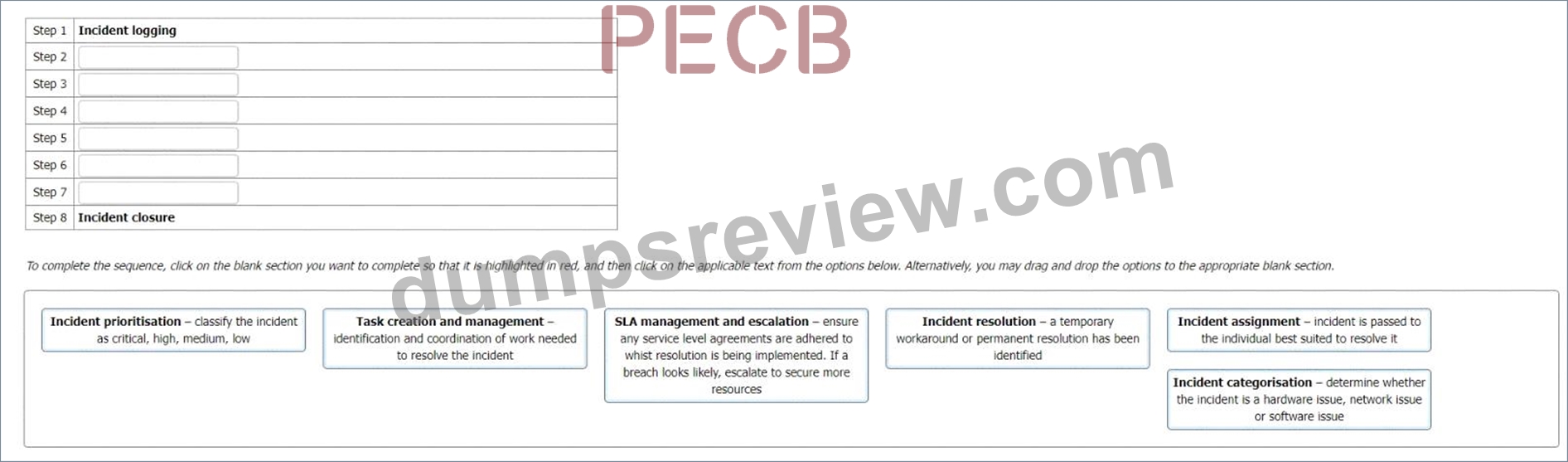
Answer:
Explanation: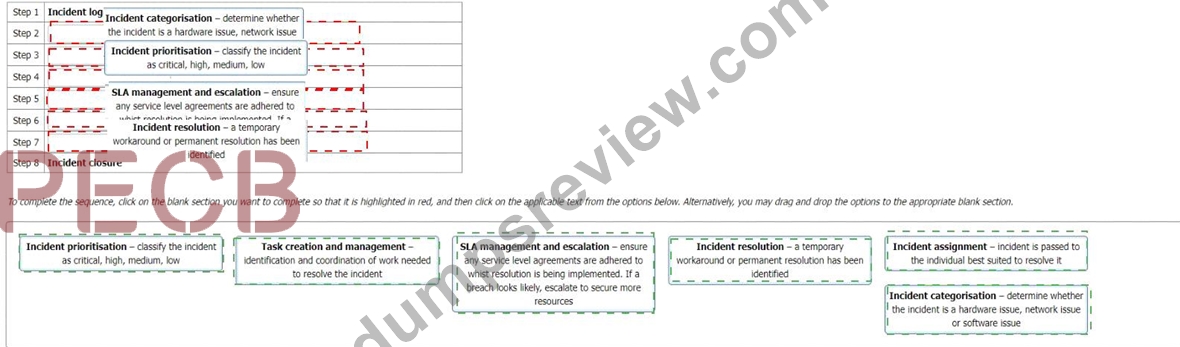
Explanation
Step 1 = Incident logging Step 2 = Incident categorisation Step 3 = Incident prioritisation Step 4 = Incident assignment Step 5 = Task creation and management Step 6 = SLA management and escalation Step 7 = Incident resolution Step 8 = Incident closure The order of the stages in the information security incident management process should follow a logical sequence that ensures a quick, effective, and orderly response to the incidents, events, and weaknesses. The order should also be consistent with the best practices and guidance provided by ISO/IEC 27001:2022 and ISO/IEC 27035:2022. Therefore, the following order is suggested:
Step 1 = Incident logging: This step involves recording the details of the potential incident, event, or weakness, such as the date, time, source, description, impact, and reporter. This step is important to provide a traceable record of the incident and to facilitate the subsequent analysis and response. This step is related to control A.16.1.1 of ISO/IEC 27001:2022, which requires the organization to establish responsibilities and procedures for the management of information security incidents, events, and weaknesses. This step is also related to clause 6.2 of ISO/IEC 27035:2022, which provides guidance on how to log the incidents, events, and weaknesses.
Step 2 = Incident categorisation: This step involves determining the type and nature of the incident, event, or weakness, such as whether it is a hardware issue, network issue, or software issue. This step is important to classify the incident and to assign it to the appropriate resolver or team. This step is related to control A.16.1.2 of ISO/IEC 27001:2022, which requires the organization to report information security events and weaknesses as quickly as possible through appropriate management channels. This step is also related to clause 6.3 of ISO/IEC 27035:2022, which provides guidance on how to categorize the incidents, events, and weaknesses.
Step 3 = Incident prioritisation: This step involves assessing the severity and urgency of the incident, event, or weakness, and classifying it as critical, high, medium, or low. This step is important to prioritize the incident and to allocate the necessary resources and time for the response. This step is related to control A.16.1.3 of ISO/IEC 27001:2022, which requires the organization to assess and prioritize information security events and weaknesses in accordance with the defined criteria. This step is also related to clause 6.4 of ISO/IEC 27035:2022, which provides guidance on how to prioritize the incidents, events, and weaknesses.
Step 4 = Incident assignment: This step involves passing the incident, event, or weakness to the individual or team who is best suited to resolve it, based on their skills, knowledge, and availability.
This step is important to ensure that the incident is handled by the right person or team and to avoid delays or confusion. This step is related to control A.16.1.4 of ISO/IEC 27001:2022, which requires the organization to respond to information security events and weaknesses in a timely manner, according to the agreed procedures. This step is also related to clause 6.5 of ISO/IEC 27035:2022, which provides guidance on how to assign the incidents, events, and weaknesses.
Step 5 = Task creation and management: This step involves identifying and coordinating the work needed to resolve the incident, event, or weakness, such as performing root cause analysis, testing solutions, implementing changes, and documenting actions. This step is important to ensure that the incident is resolved effectively and efficiently, and that the actions are tracked and controlled. This step is related to control A.16.1.5 of ISO/IEC 27001:2022, which requires the organization to apply lessons learned from information security events and weaknesses to take corrective and preventive actions. This step is also related to clause 6.6 of ISO/IEC 27035:2022, which provides guidance on how to create and manage the tasks for the incidents, events, and weaknesses.
Step 6 = SLA management and escalation: This step involves ensuring that any service level agreements (SLAs) are adhered to while the resolution is being implemented, and that the incident is escalated to a higher level of authority or support if a breach looks likely or occurs. This step is important to ensure that the incident is resolved within the agreed time frame and quality, and that any deviations or issues are communicated and addressed. This step is related to control A.16.1.6 of ISO/IEC 27001:2022, which requires the organization to communicate information security events and weaknesses to the relevant internal and external parties, as appropriate. This step is also related to clause 6.7 of ISO/IEC
27035:2022, which provides guidance on how to manage the SLAs and escalations for the incidents, events, and weaknesses.
Step 7 = Incident resolution: This step involves applying a temporary workaround or a permanent solution to resolve the incident, event, or weakness, and restoring the normal operation of the information and information processing facilities. This step is important to ensure that the incident is resolved completely and satisfactorily, and that the information security is restored to the desired level.
This step is related to control A.16.1.7 of ISO/IEC 27001:2022, which requires the organization to identify the cause of information security events and weaknesses, and to take actions to prevent their recurrence or occurrence. This step is also related to clause 6.8 of ISO/IEC 27035:2022, which provides guidance on how to resolve the incidents, events, and weaknesses.
Step 8 = Incident closure: This step involves closing the incident, event, or weakness, after verifying that it has been resolved satisfactorily, and that all the actions have been completed and documented.
This step is important to ensure that the incident is formally closed and that no further actions are required. This step is related to control A.16.1.8 of ISO/IEC 27001:2022, which requires the organization to collect evidence and document the information security events and weaknesses, and the actions taken. This step is also related to clause 6.9 of ISO/IEC 27035:2022, which provides guidance on how to close the incidents, events, and weaknesses.
References:
ISO/IEC 27001:2022, Information technology - Security techniques - Information security management systems - Requirements1 PECB Candidate Handbook ISO/IEC 27001 Lead Auditor2 ISO 27001:2022 Lead Auditor - PECB3 ISO 27001:2022 certified ISMS lead auditor - Jisc4 ISO/IEC 27001:2022 Lead Auditor Transition Training Course5 ISO 27001 - Information Security Lead Auditor Course - PwC Training Academy6 ISO/IEC 27035:2022, Information technology - Security techniques - Information security incident management
NEW QUESTION # 140
You are an ISMS audit team leader tasked with conducting a follow-up audit at a client's data centre.
Following two days on-site you conclude that of the original 12 minor and 1 major nonconformities that prompted the follow-up audit, only 1 minor nonconformity still remains outstanding.
Select four options for the actions you could take.
- A. Recommend that the outstanding minor nonconformity is dealt with at the next surveillance audit
- B. Conduct an unannounced follow-up audit on-site to review the one outstanding minor nonconformity once it has been cleared
- C. Agree with the auditee/audit client how the remaining nonconformity will be cleared, by when, and how its clearance will be verified
- D. Close the follow-up audit as the organisation has demonstrated it is committed to clearing the nonconformities raised
- E. Recommend suspension of the organisation's certification as they have failed to implement the agreed corrections and corrective actions within the agreed timescale
- F. Advise the individual managing the audit programme of any decision taken regarding the outstanding nonconformity
- G. Advise the auditee that you will arrange for the next audit to be an online audit to deal with the outstanding nonconformity
- H. Note the progress made but hold the audit open until all corrective action has been cleared
Answer: C,D,F,H
Explanation:
The four options for the actions you could take are A, C, F, and G.
These options are consistent with the guidance and requirements of ISO 19011:2018, Clause 6.712. You could agree with the auditee/audit client how the remaining nonconformity will be cleared, by when, and how its clearance will be verified (A), and document the agreement in the audit report1. You could close the follow-up audit as the organisation has demonstrated it is committed to clearing the nonconformities raised, and report the outcome to the audit client and other relevant parties1. You could note the progress made but hold the audit open until all corrective action has been cleared (F), and determine the need for another follow-up audit or other actions1. You could also advise the individual managing the audit programme of any decision taken regarding the outstanding nonconformity (G), as they are responsible for the overall management and coordination of the audit programme3. The other options are either not appropriate or not necessary for the situation. You should not recommend that the outstanding minor nonconformity is dealt with at the next surveillance audit (B), as this may compromise the audit objectives and the audit programme1. You should not recommend suspension of the organisation's certification as they have failed to implement the agreed corrections and corrective actions within the agreed timescale (D), as this is not within your role or authority as an ISMS auditor4. You should not advise the auditee that you will arrange for the next audit to be an online audit to deal with the outstanding nonconformity (E), as this may not be feasible or effective depending on the nature and complexity of the nonconformity1. You should not conduct an unannounced follow-up audit on-site to review the one outstanding minor nonconformity once it has been cleared (H), as this may not be in accordance with the audit agreement or the audit programme1. References: 1: ISO 19011:2018, Guidelines for auditing management systems, Clause 6.7 \n2: PECB Certified ISO/IEC 27001 Lead Auditor Exam Preparation Guide, Domain 6:
Closing an ISO/IEC 27001 audit \n3: ISO 19011:2018, Guidelines for auditing management systems, Clause
5.3 \n4: ISO/IEC 27006:2022, Information technology - Security techniques - Requirements for bodies providing audit and certification of information security management systems, Clause 9.6
NEW QUESTION # 141
Which two of the following phrases would apply to "plan" in relation to the Plan-Do-Check-Act cycle for a business process?
- A. Providing ICT assets
- B. Retaining documentation
- C. Organising changes
- D. Retaining documentation
- E. Setting objectives
- F. Training staff
Answer: E,F
Explanation:
The Plan-Do-Check-Act (PDCA) cycle is a four-step method for implementing and improving processes, products, or services. The "plan" phase involves establishing the objectives and processes necessary to deliver the desired results. This may include setting SMART goals, identifying resources, defining roles and responsibilities, conducting risk assessments, and developing plans for training, communication, and monitoring.
References:
ISO/IEC 27001:2022 Lead Auditor (Information Security Management Systems) objectives and content from Quality.org and PECB ISO 19011:2018 Guidelines for auditing management systems [Section 5.3.1]
NEW QUESTION # 142
......
ISO-IEC-27001-Lead-Auditor Question Bank: Free PDF Download Recently Updated Questions: https://examtorrent.dumpsreview.com/ISO-IEC-27001-Lead-Auditor-exam-dumps-review.html
